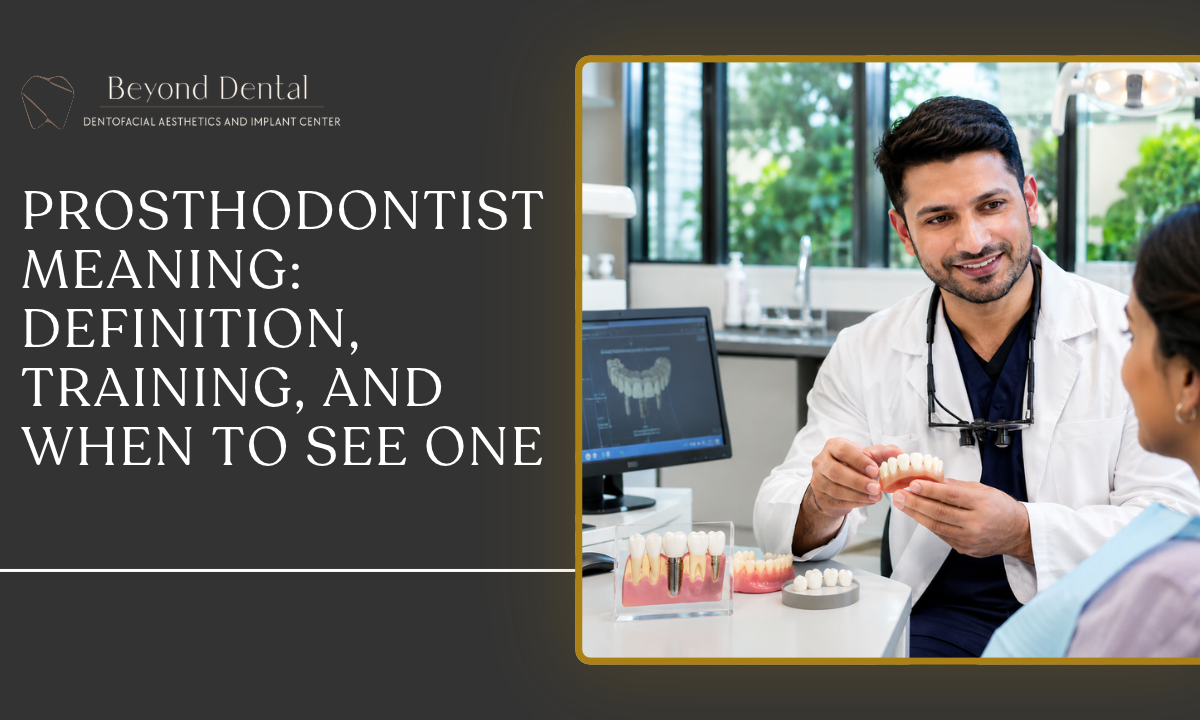
If a general dentist has recommended you see a “prosthodontist”, or if you have come across the word while researching a dental treatment, you are not alone in wondering what it actually means. Prosthodontist is one of the least familiar words in dentistry outside the profession, but it describes one of the most specialised dental fields. For anyone considering dental crowns, dental implants, dentures,veneers or a smile makeover, knowing what a prosthodontist does changes the quality of care you can access.
This guide explains the meaning of “prosthodontist” in plain English and in five Indian languages, covers the training that separates a prosthodontist from a regular dentist, and lists the specific situations where you should see a prosthodontist rather than any dentist. For a direct comparison between the two, our existing guide on what is a prosthodontist and how they are different from a regular dentist is the perfect companion read.
What does “prosthodontist” mean?
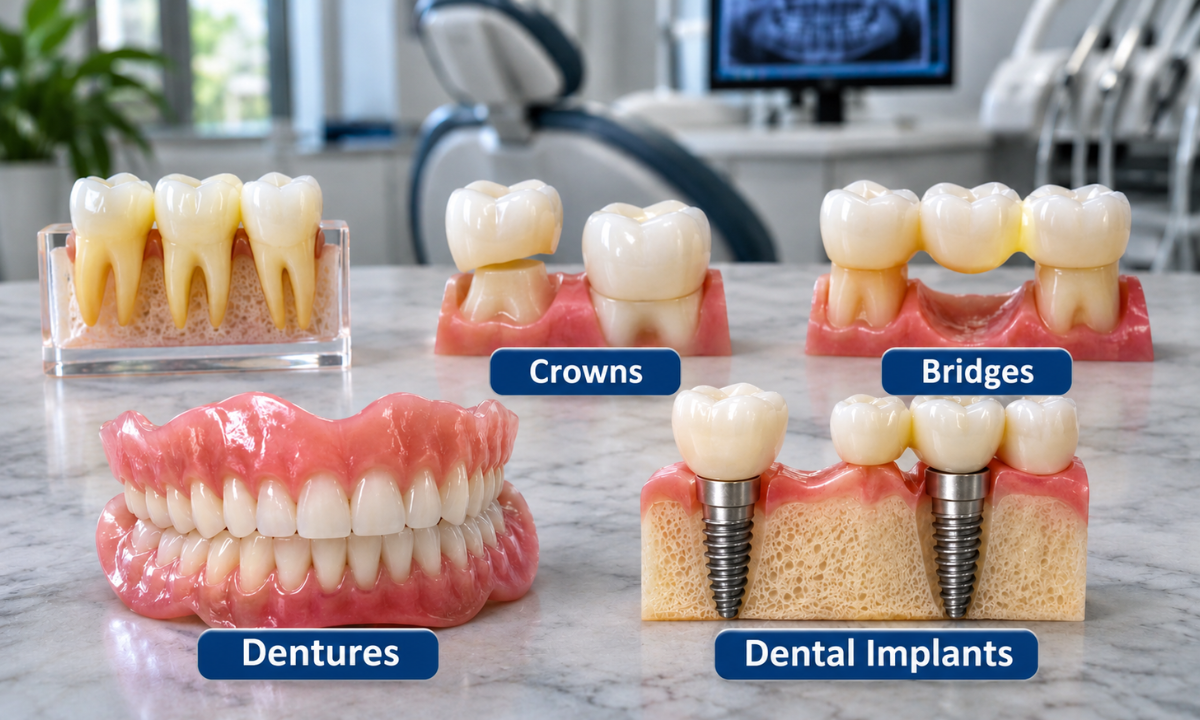
The word “prosthodontist” comes from two Greek roots. “Prosthesis” means “addition” or “something attached to the body to replace a missing part”. “Odont” means “tooth”. A prosthodontist, literally, is a specialist in adding, restoring, and replacing teeth.
In modern dentistry, a prosthodontist is a dental specialist who has completed additional postgraduate training (an MDS in Prosthodontics in India) focused on the design, fabrication, and fitting of dental prostheses. These prostheses include crowns, bridges, dentures, dental implants, veneers, and complex full-mouth rehabilitations.
Where a general dentist treats a broad range of everyday dental problems (cavities, cleanings, basic fillings, routine extractions), a prosthodontist is the specialist general dentists refer patients to when the case involves complex restoration, aesthetic reconstruction, or any permanent replacement of teeth.
Think of it this way: your family physician handles most health concerns, but when the case needs orthopaedic expertise, they refer you to an orthopaedic surgeon. In dentistry, the prosthodontist plays the equivalent role for teeth restoration and replacement.
Prosthodontist meaning in Indian languages
India has 22 scheduled languages and dentistry is practised across all of them. These are the most-searched regional translations of “prosthodontist”, with explanation.
Prosthodontist meaning in Tamil (தமிழ்)
Prosthodontist is translated as “செயற்கை பல் மருத்துவர்” (seyarkai pal maruthuvar), which literally means “artificial teeth doctor”. A more precise rendering is “பல் மற்றும் முக செயற்கை உறுப்பு வல்லுநர்” (dental and facial prosthesis specialist).
Prosthodontist meaning in Malayalam (മലയാളം)
In Malayalam, prosthodontist is “കൃത്രിമ ദന്ത വിദഗ്ധൻ” (krithrima dantha vidagdhan), meaning “artificial teeth specialist” or more formally “ദന്ത പ്രോസ്ഥോഡോണ്ടിക് വിദഗ്ധൻ”.
Prosthodontist meaning in Hindi (हिन्दी)
In Hindi, prosthodontist is “दंत प्रोस्थेटिक विशेषज्ञ” (dant prosthetic visheshagya) or “कृत्रिम दंत विशेषज्ञ”, meaning “artificial teeth specialist”.
Prosthodontist meaning in Kannada (ಕನ್ನಡ)
In Kannada, prosthodontist is “ಕೃತಕ ಹಲ್ಲಿನ ತಜ್ಞ” (kruthaka hallina tajna), meaning “artificial teeth specialist”.
Prosthodontist meaning in Telugu (తెలుగు)
In Telugu, prosthodontist is “కృత్రిమ దంత నిపుణుడు” (krithrima danta nipunudu), meaning “artificial teeth specialist”.
The common thread across all Indian translations is “artificial teeth specialist”, which captures the core of what a prosthodontist does: build, fit, and restore replacement teeth and complex dental structures.
What a prosthodontist actually does (the full scope)
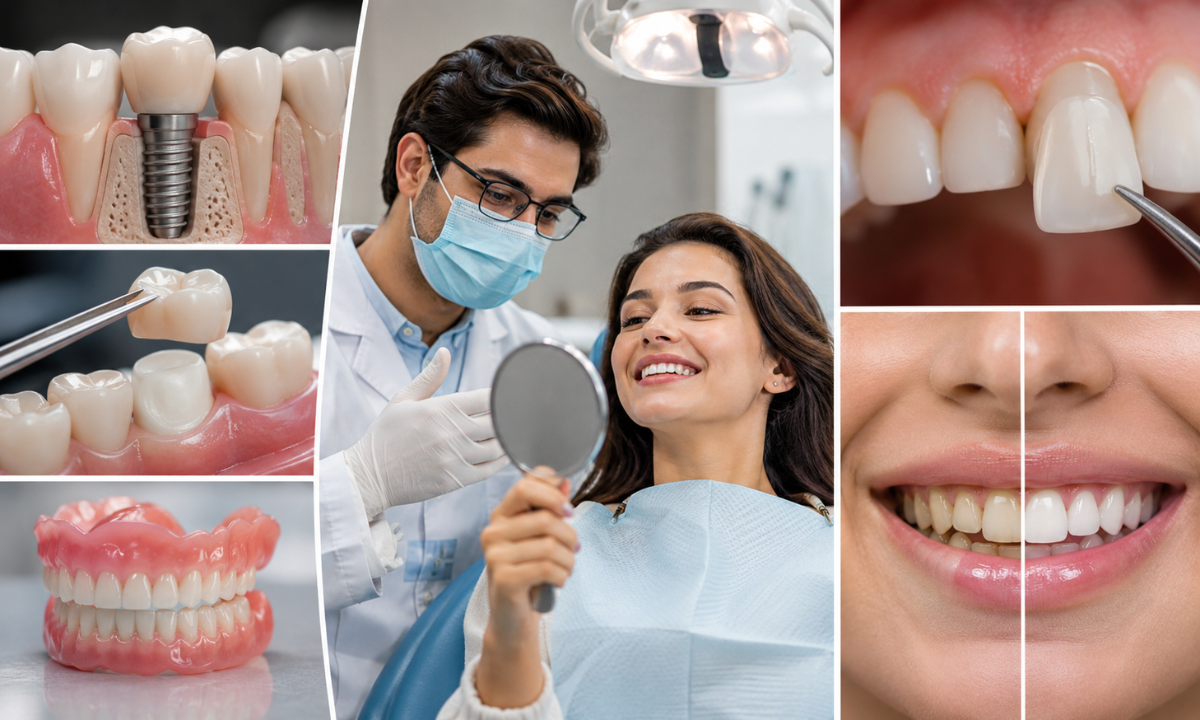
The clinical scope of a prosthodontist in India is wider than most patients realise. A fully qualified prosthodontist handles the following areas.
Dental implants (single, multiple, and full-arch): Implant placement, implant-supported crowns, implant-supported bridges, and all-on-4 or all-on-6 full-arch implant rehabilitations. See our service page on dental implants and dental implants in Bangalore for detail.
Dental crowns and bridges: Design and fit of single crowns (zirconia, ceramic, metal, PFM), multi-unit bridges, and complex fixed prosthetic restorations. Our crown types compared blog and dental crowns service page cover the specific treatments.
Dentures (removable prostheses): Complete dentures, partial dentures, and implant-supported overdentures. See our dentures service page and our comparison blog dental implants vs dentures.
Dental veneers: Thin shells of ceramic or composite fitted on the front surface of teeth to correct colour, shape, and minor alignment issues. See our dental veneers service.
Smile designing and smile makeovers: Complete aesthetic reconstruction combining multiple procedures for overall appearance. Our smile designing blog and smile designing service page go deeper.
Full mouth rehabilitation: Rebuilding the entire upper and lower teeth together, typically for patients with severe decay, worn-down teeth, or complex bite problems. See our pillar what is full mouth rehabilitation and who needs it and the full mouth rehabilitation service page.
Maxillofacial prosthodontics: The sub-specialty that reconstructs the face itself: patients who have lost part of the jaw, face, or oral structures due to cancer surgery, trauma, or congenital conditions. Our dedicated blog on maxillofacial prosthodontics: what it is, who needs it, and what to expect covers this specialised area.
TMJ and occlusion: Managing complex bite problems, teeth grinding consequences, and jaw joint disorders that need prosthetic intervention.
Cosmetic dentistry at a complex level: Beyond simple whitening or bonding, prosthodontists handle the cases where appearance depends on reconstruction, not just correction. See our cosmetic dentistry service page and our blog on what makes someone a candidate for cosmetic dentistry.
How a prosthodontist is trained in India
Becoming a prosthodontist in India is a 8 to 10 year journey of formal education.
Step 1: BDS (Bachelor of Dental Surgery) – 5-year undergraduate dental degree including 4 years of academic training and 1 year of mandatory rotational internship. This qualifies the person as a general dentist, licensed to practice dentistry across all basic areas.
Step 2: NEET MDS entrance exam – The National Eligibility cum Entrance Test for MDS is one of India’s most competitive medical entrance exams. Prosthodontics seats are highly sought because the specialty combines clinical complexity with aesthetic artistry.
Step 3: MDS in Prosthodontics and Crown & Bridge – A 3-year postgraduate specialty program covering fixed prosthodontics (crowns, bridges, veneers), removable prosthodontics (dentures), implant prosthodontics, maxillofacial prosthodontics, occlusion, aesthetic dentistry, dental materials, and prosthodontic laboratory procedures. Includes thesis work, clinical rotations, hundreds of supervised cases, and board-level final examinations.
Step 4: Dental Council of India (DCI) registration – After MDS, the dentist registers as a specialist with the Dental Council of India and the respective State Dental Council. Only then can they legally practice and advertise as a “prosthodontist”.
Step 5 (optional): Fellowships and advanced certifications – Many prosthodontists pursue additional training in dental implants (ICOI, ITI fellowships), digital dentistry, occlusion (Dawson, Pankey), aesthetic dentistry, or maxillofacial prosthetics.
Total time from starting BDS to becoming a fully qualified prosthodontist: minimum 8 years. A specialist with 5+ years of post-MDS practice is considered experienced.
Prosthodontist vs general dentist vs orthodontist vs implantologist
Four titles that patients commonly confuse. Here is how they differ.
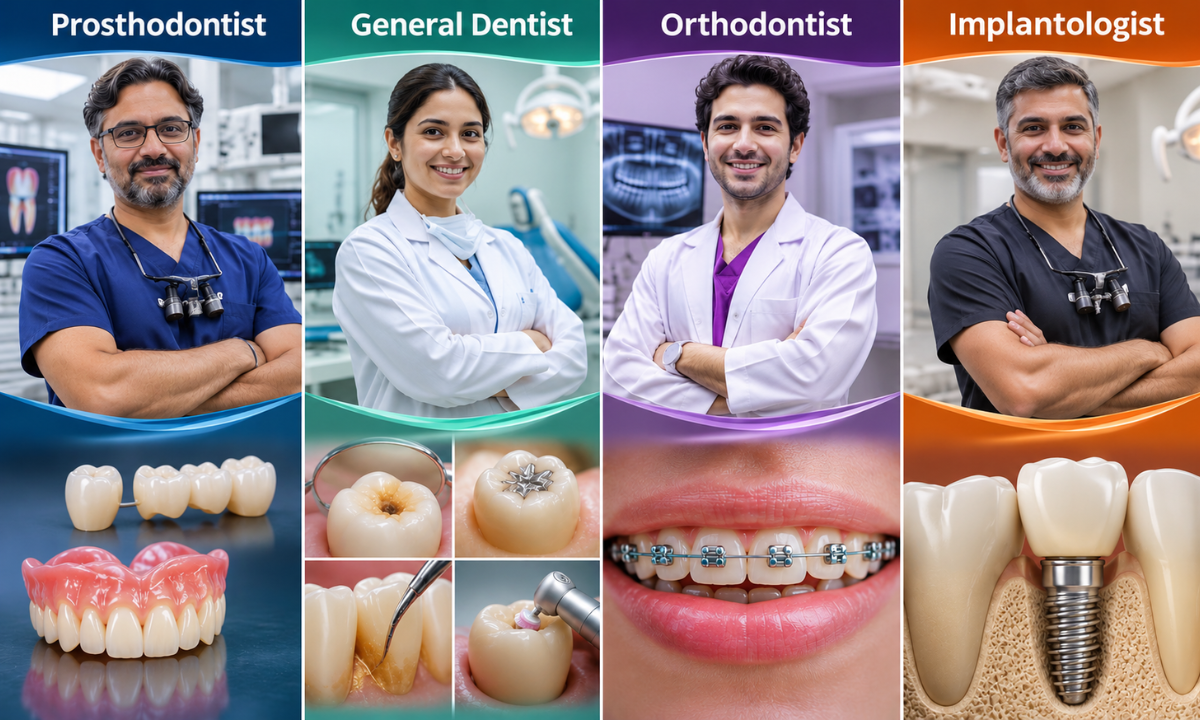
| Specialist | Training | Primary Focus |
|---|---|---|
| General dentist | BDS (5 years) | Broad dentistry: cleaning, fillings, routine extractions, basic crowns, root canals, patient education |
| Prosthodontist | BDS + MDS Prosthodontics (8 years) | Restoration and replacement: crowns, bridges, veneers, dentures, implants, full-mouth rehabilitation, maxillofacial prosthetics |
| Orthodontist | BDS + MDS Orthodontics (8 years) | Tooth movement and alignment: braces, clear aligners, bite correction, jaw growth management |
| Implantologist | Can be a general dentist with implant training, or a prosthodontist/oral surgeon with implant specialisation | Dental implant placement and restoration (scope depends on background training) |
Prosthodontist and dentist difference, in plain terms:
Every prosthodontist is a dentist, but not every dentist is a prosthodontist. A prosthodontist has three additional years of specialised training specifically in restoration and replacement. For routine cleanings, fillings, and simple extractions, a general dentist is perfectly appropriate. For complex restorative or aesthetic work, a prosthodontist is the specialist.
Prosthodontist and implantologist meaning:
An implantologist is a dentist whose practice focuses on dental implants. The important distinction is scope: a general dentist with implant training may place implants but not always design the full prosthetic restoration. A prosthodontist who is also an implantologist handles both placement and restoration as a complete workflow, which is why implant cases done by prosthodontists typically have better aesthetic outcomes and fewer complications.
Prosthodontist vs orthodontist:
Orthodontists move teeth that already exist. Prosthodontists replace or restore teeth that are damaged, missing, or aesthetically compromised. Many complex adult cases need both working together.
8 situations when you should see a prosthodontist (not a general dentist)
1. You are considering dental implants: Implants need precise planning, placement, and prosthetic restoration. A prosthodontist’s training covers both the placement and the final crown or bridge, which is why implant outcomes are more predictable with prosthodontist-led cases.
2. You need multiple crowns or a bridge: Multi-unit crown and bridge work requires exact occlusion planning. A general dentist can do single crowns, but multiple crowns on front teeth or long-span bridges benefit from specialist handling.
3. You are considering dental veneers: Veneers are 50 percent material science and 50 percent aesthetic design. A prosthodontist is trained in both.
4. You have severely worn, broken, or damaged teeth: Full mouth reconstruction is one of the most complex procedures in dentistry and sits squarely within prosthodontics.
5. You need complete or partial dentures: The difference between a well-fitted denture and a poorly-fitted one is often the difference between specialist and generalist work.
6. You want a complete smile makeover: Smile designing combines multiple procedures (whitening, veneers, crowns, gum reshaping, alignment) into one aesthetic plan. Prosthodontists lead this planning. See our smile designing and makeover service.
7. You have TMJ problems and complex bite issue:. Occlusion (how teeth meet) is a core prosthodontic concern.
8. You have lost part of your jaw or face: Maxillofacial prosthodontists specialise in these cases, which require custom prosthetics that restore both function and appearance.
If your dental problem falls into any of these categories, start with a prosthodontist consultation. For routine cleaning, fillings, and basic dentistry, a general dentist is the right first point of contact. For when to visit either, our guide on how often should you really visit the dentist sets realistic expectations.
What to expect at a prosthodontist consultation
A prosthodontist consultation is more thorough than a routine dental visit because the planning stakes are higher.
1. Comprehensive dental history and examination: Beyond the complaint, the prosthodontist examines bite, jaw joint, gums, existing restorations, and overall oral health. See dental crowns vs fillings: which treatment might you need for an example of the kind of decision made during exam.
2. Imaging: Panoramic X-ray, periapical X-rays, and often a CBCT (3D) scan for implant or complex cases.
3. Impressions or digital scans: Traditional putty impressions or digital intraoral scanning to create accurate models of your teeth.
4. Smile analysis (for aesthetic cases): Photographs, video analysis, and digital smile design software to plan how your smile will look post-treatment. Our blog on smile designing explains this process.
5. Treatment plan with options: Multiple treatment options with trade-offs, timelines, and prognosis explained.
6. Mock-ups (for complex aesthetic cases): Wax mock-up or 3D-printed preview of the planned outcome so you can see before committing.
A first prosthodontist consultation typically lasts 45 to 90 minutes, significantly longer than a general dentist visit.
How to verify a prosthodontist’s qualifications in India
Before committing to any prosthodontist, verify credentials through these checks.
Check Dental Council of India registration: Every qualified dentist and specialist is registered with the Dental Council of India (DCI) and their respective State Dental Council. Registration numbers are public.
Confirm MDS qualification: Ask for the MDS certificate from a recognised Indian dental college. Beware of practitioners calling themselves “prosthodontists” who only have BDS with short-term training certificates.
Check Indian Prosthodontic Society (IPS) membership: The Indian Prosthodontic Society is the national association of prosthodontists. Active membership is a positive signal.
Verify years of post-MDS experience: Most reputable Indian prosthodontists have 5+ years of post-specialty experience.
Look at case photographs: Actual before/after cases from the practitioner tell you more than any marketing material.
Ask about continuing education: Dentistry evolves fast. Prosthodontists who attend conferences, workshops, and advanced courses tend to offer better care.
FAQs
Is a prosthodontist the same as a cosmetic dentist?
Not exactly. Cosmetic dentistry is not a recognised specialty in India. “Cosmetic dentist” is a description any dentist can use. “Prosthodontist” is a formally recognised dental specialty with MDS qualification. Most high-quality cosmetic work in India is done by prosthodontists.
Prosthodontist meaning in Tamil?
In Tamil, prosthodontist translates to “செயற்கை பல் மருத்துவர்” (seyarkai pal maruthuvar), literally “artificial teeth doctor”.
Prosthodontist meaning in Malayalam?
In Malayalam, prosthodontist translates to “കൃത്രിമ ദന്ത വിദഗ്ധൻ” (krithrima dantha vidagdhan), meaning “artificial teeth specialist”.
Prosthodontist meaning in Hindi?
In Hindi, prosthodontist translates to “दंत प्रोस्थेटिक विशेषज्ञ” or “कृत्रिम दंत विशेषज्ञ”, meaning “artificial teeth specialist”.
Prosthodontist and implantologist meaning: are they the same?
No, but they overlap. A prosthodontist is a dental specialist with MDS in Prosthodontics. An implantologist is any dentist whose practice focuses on dental implants. A prosthodontist who focuses on implants is technically both.
Is a prosthodontist a doctor?
A prosthodontist holds dental degrees (BDS + MDS) and is addressed as “Dr.” in India. Dentistry is not the same as general medicine (MBBS), but prosthodontists are qualified medical practitioners within the dental field.
How is a prosthodontist different from a regular dentist?
A prosthodontist has an additional 3-year specialty qualification (MDS Prosthodontics) beyond the standard BDS of a regular dentist. Our detailed comparison on what is a prosthodontist and how are they different from a regular dentist covers this in full.
Can a prosthodontist do root canals and fillings?
Yes, prosthodontists are fully qualified dentists and can perform all general dental procedures. In practice, most prosthodontists focus on specialty work and refer routine procedures.
Who should I see first: a general dentist or a prosthodontist?
For any new patient with a routine concern (toothache, cleaning, cavity), start with a general dentist. For complex cases (missing multiple teeth, severe wear, planning implants or veneers, smile makeover), start directly with a prosthodontist.
What does a prosthodontist charge?
Fees vary by case complexity, procedure, materials, and clinic. For specific procedures, our pricing content on tooth cap cost in Bangalore,smile makeover cost in India, and dental implants cost in Bangalore covers realistic ranges.
How do I find a good prosthodontist in Bangalore?
Verify DCI registration and MDS Prosthodontics qualification, check Indian Prosthodontic Society membership, review case portfolios, and read patient outcomes. For prosthodontic care at Beyond Dental, our prosthodontist team handles complex restorative, cosmetic, and full-mouth rehabilitation cases across our clinic and the Vasanth Nagar dental care practice.
Is prosthodontics a recognised specialty?
Yes, prosthodontics is one of the nine officially recognised dental specialties by the Dental Council of India, alongside orthodontics, oral surgery, periodontics, endodontics, oral pathology, public health dentistry, paediatric dentistry, and oral medicine and radiology.
Thinking about a prosthodontic treatment?
If you have been told you need a crown, bridge, denture, implant, veneer, or complete smile reconstruction, seeing a qualified prosthodontist from the start saves time, money, and complications later.
Beyond Dental is a Vasanth Nagar-based dental practice led by MDS-qualified prosthodontists and specialists in complex restorative and aesthetic dentistry. Our full range of prosthodontic services includes dental implants, dental crowns,dentures, dental veneers, smile designing and makeover, and full mouth rehabilitation.
Book a prosthodontist consultation at Beyond Dental today.