
Most people visit the dentist only when something hurts. And honestly? That is one of the most expensive dental habits you can have.
Studies show that nearly 60% of adults avoid the dentist until pain forces them to go. By that point, what could have been a simple cleaning becomes a root canal, a crown, or worse. The good news is that staying ahead of dental problems does not require monthly visits or complicated routines.
If you have been wondering how often you should really visit the dentist, you are not alone. The answer is not the same for everyone, and that is exactly what this blog will explain. Whether you are in Vasanth Nagar, Bangalore or anywhere else, this guide will help you figure out a dental visit schedule that works for your specific situation.
Key Takeaways
- The standard “twice a year” rule does not apply to everyone
- Your dental visit frequency depends on your age, health, and risk factors
- Skipping cleanings leads to bigger problems and higher costs down the line
- Children, seniors, and people with certain health conditions need more frequent visits
- Regular dental checkups are one of the most cost-effective health habits you can build
The Quick Answer: How Often Should You Visit the Dentist?
For most healthy adults, visiting the dentist twice a year (every 6 months) is the right frequency. This includes a professional cleaning and a full checkup. However, some people need visits every 3 to 4 months, while others with excellent oral health may be fine with once a year. Your dentist is the best person to determine what is right for you.
Where Does the “Twice a Year” Rule Come From?
The twice-a-year recommendation has been around since the 1950s and was popularized largely through toothpaste advertising. But it actually has solid clinical backing behind it.
Every 6 months, plaque builds up in areas your toothbrush and floss cannot fully reach. A professional cleaning removes this buildup before it hardens into tartar, which can only be removed by a dentist. Beyond cleaning, these visits allow your dentist to:
- Spot cavities in their earliest, most treatable stage
- Check for signs of gum disease before it progresses
- Screen for oral cancer (a quick but critical part of every checkup)
- Review any changes in your bite, jaw, or existing dental work
Think of it like a car service. You do not wait for the engine light to come on. You go in regularly to make sure nothing is quietly going wrong.
Not Everyone Needs the Same Schedule
This is where it gets personal. A blanket “twice a year” rule does not account for the wide range of individual health factors. Here is a clearer breakdown:
Low-Risk Patients: Once a Year May Be Enough
If you have all of the following, your dentist may clear you for annual visits:
- No history of cavities in recent years
- No gum disease or bleeding gums
- Good home oral care routine (brushing twice daily, flossing)
- No systemic conditions affecting oral health
Average-Risk Patients: Stick to Every 6 Months
Most people fall into this category. If you occasionally get cavities, have minor gum sensitivity, or are not 100% consistent with flossing, twice a year is the safe standard.
High-Risk Patients: Every 3 to 4 Months
You are in the high-risk group if any of these apply to you:
- Smokers or tobacco users: Tobacco dramatically increases your risk of gum disease and oral cancer
- Diabetics: High blood sugar weakens the immune response in your gums, making infections more likely
- Pregnant women: Hormonal changes increase the risk of pregnancy gingivitis
- People with a history of gum disease (periodontitis): Once treated, it needs regular monitoring to prevent recurrence
- Anyone with dry mouth: Saliva protects teeth, and reduced saliva flow accelerates decay
- Patients with crowns, implants, or bridges: These need regular monitoring to ensure they are holding up correctly
Dental Visit Frequency by Age Group
Age plays a big role in how often you should be in the dental chair. Here is a simple reference table:
| Age Group | Recommended Visit Frequency | Key Focus Areas |
|---|---|---|
| Infants and Toddlers (0-3 yrs) | First visit by age 1, then every 6 months | Early cavity prevention, bite development |
| Children (4-12 yrs) | Every 6 months | Cavity checks, fluoride treatments, sealants |
| Teenagers (13-19 yrs) | Every 6 months | Wisdom tooth monitoring, orthodontic review |
| Adults (20-50 yrs) | Every 6-12 months based on risk | Gum health, restorations, oral cancer screening |
| Seniors (50+ yrs) | Every 3-6 months | Dry mouth, gum recession, implant and denture care |
Seniors, in particular, are often underserved when it comes to dental care. Medications that cause dry mouth, reduced dexterity for brushing, and a higher likelihood of gum recession all make regular visits especially important.
What Happens When You Skip Dental Visit
Let us be direct: skipping your dental appointments does not save you money. It delays the cost and multiplies it.
Here is a realistic timeline of what can happen:
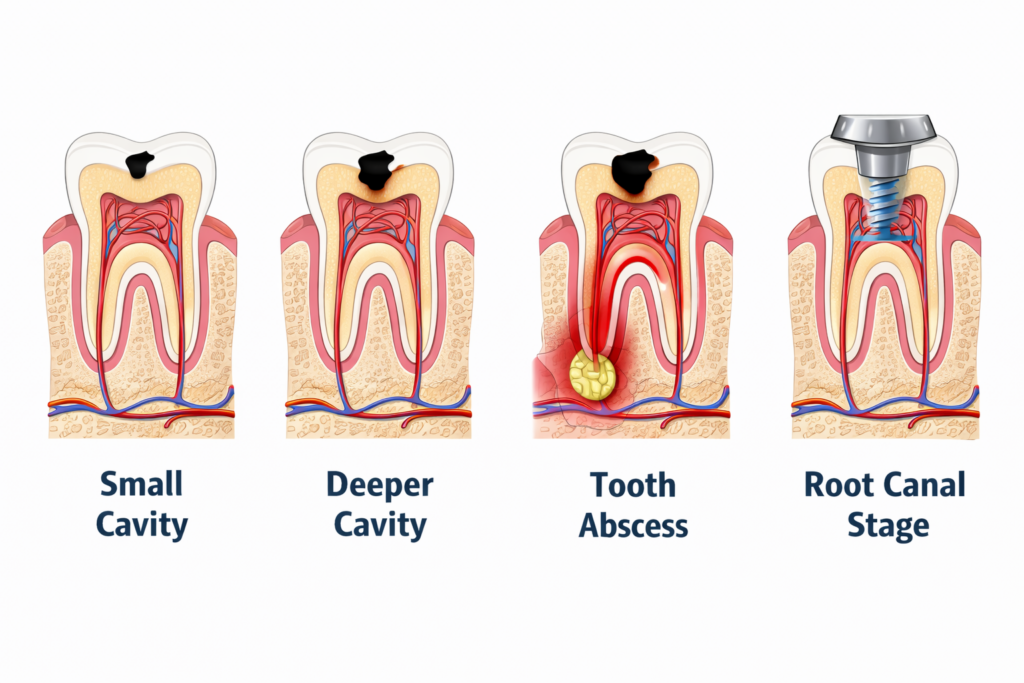
- 6 months skipped: Plaque hardens into tartar. Basic cleaning becomes a deeper scaling procedure.
- 1 year skipped: A small cavity that could have been filled with a simple composite goes undetected. It grows.
- 2 years skipped: That cavity reaches the nerve. Now it is a root canal and crown, which can cost 5 to 10 times more than the original filling.
- 3+ years skipped: Gum disease may have progressed silently. Bone loss around teeth begins. Treatment becomes more intensive and expensive.
The pattern is consistent: dental problems that are caught early are almost always easier and cheaper to treat.
Signs You Should Visit the Dentist Sooner, Not Later
Do not wait for your next scheduled visit if you notice any of the following:
- Tooth sensitivity to hot, cold, or sweet foods even brief sharp pain is a sign something is wrong beneath the enamel
- Bleeding gums when brushing or flossing healthy gums should never bleed, and this is often the earliest sign of gum disease
- Persistent bad breath that does not go away with brushing this could point to hidden decay, gum infection, or a deeper digestive issue
- Pain or discomfort in any tooth, jaw, or ear dental pain that radiates is rarely minor and should never be ignored or delayed
- A loose tooth in adults this is never normal and usually signals advanced gum disease or significant bone loss around the tooth
- White patches, sores, or lumps in the mouth that do not heal within 2 weeks these need to be evaluated promptly as they can be early signs of oral cancer
- Swelling in the face, jaw, or neck this may indicate a dental abscess or infection that can spread quickly if left untreated
- A cracked or chipped tooth, even if it does not hurt yet cracks worsen over time with chewing pressure and can eventually lead to tooth loss
Any of these symptoms deserve prompt attention. At Beyond Dental, the team can assess and treat these issues quickly before they become serious.
How to Build a Dental Habit That Actually Sticks
Knowing you should visit the dentist is one thing. Actually doing it consistently is another. Here are a few practical ways to make dental visits a non-negotiable part of your routine:
- Schedule your next appointment before you leave the clinic. This removes the friction of booking later.
- Set a calendar reminder 1 weeks before your appointment is due.
- Pair your dental visits with another routine, like your annual health checkup.
- Choose a clinic close to home or work. Convenience removes excuses. If you are in Vasanth Nagar or nearby areas of Bangalore, having a trusted dental clinic in Vasanth Nagar within easy reach makes consistency much easier.
- Bring your children along. Building the habit early normalizes dental care for kids.

FAQ: How Often Should You Visit the Dentist?
Q: Is visiting the dentist once a year enough?
For healthy adults with no history of cavities or gum issues and a strong home care routine, once a year may be sufficient. However, most dentists recommend twice a year to catch problems early.
Q: How often should children visit the dentist?
Children should have their first dental visit by their first birthday, and then every 6 months after that. Early visits build comfort with the dentist and catch developmental issues before they worsen.
Q: Can I skip dental visits if my teeth do not hurt?
Pain is a late sign of dental problems. Most cavities, gum disease, and even oral cancer progress silently before becoming painful. Regular visits catch these conditions before they reach that stage.
Q: How often should seniors visit the dentist?
Seniors generally benefit from visits every 3 to 6 months due to higher risk factors like dry mouth, gum recession, and medication side effects that affect oral health.
Q: What does a routine dental checkup include?
A standard checkup typically includes a professional cleaning, X-rays (usually once a year), a visual exam for cavities and gum health, an oral cancer screening, and a review of any existing dental work.
Make Your Next Dental Visit Count
If you are overdue for a checkup or have been putting it off, there is no better time than now. The team at Beyond Dental, Vasanth Nagar, Bangalore provides comprehensive dental care in a comfortable, judgment-free environment. Whether it is a routine cleaning, a cavity check, or a more detailed assessment, they will help you build a plan that fits your life.
Book your appointment at Beyond Dental today and stay ahead of your oral health.