
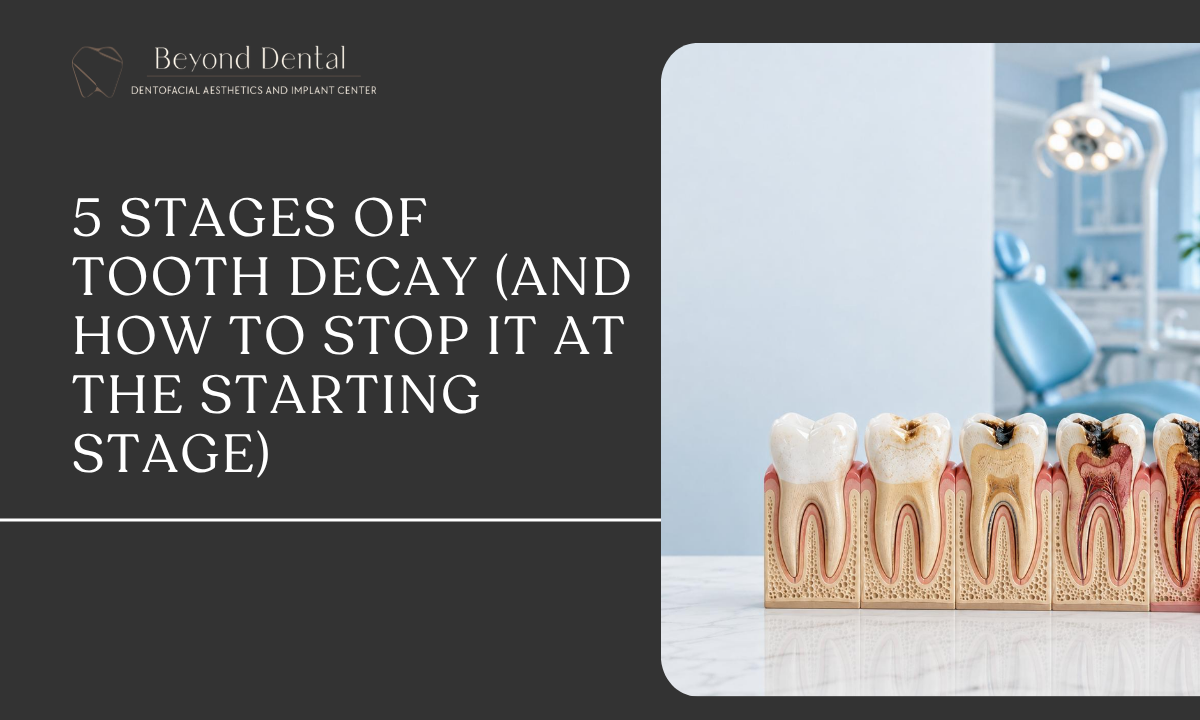
Tooth decay rarely appears overnight. It moves through distinct tooth decay stages, starting with a barely visible weak spot on the enamel and, if Left untreated, this same bacterial activity is also one of the leading causes of bad breath, so the two issues are closely linked. Recognising the starting stage early is the difference between a simple fluoride treatment and a root canal, and understanding what happens at each stage helps you know exactly when to act.
At Beyond Dental, a dental clinic in Vasanth Nagar, Bangalore, we see patients across every stage of this progression, from the earliest chalky white spot to full-blown abscesses. The good news is that decay is entirely preventable, and often reversible, if caught early enough.
What Causes Tooth Decay
Tooth decay begins with plaque, a sticky, colourless film of bacteria that forms constantly on your teeth. When you eat or drink anything containing sugar or starch, these bacteria feed on it and produce acid as a by-product. That acid attacks the enamel surface, pulling out essential minerals like calcium and phosphate.
If plaque is removed regularly through brushing and flossing, the mouth’s natural saliva can help redeposit some of these minerals and repair minor damage. But when plaque is left to build up meal after meal, day after day, the acid attacks outpace the repair process, and decay begins. This is why the timing and frequency of sugar exposure matters just as much as the total amount consumed. Frequent snacking throughout the day, even on small amounts of sugar, causes more damage than eating the same sugar in one sitting.
Tooth Decay Stages at a Glance
| Stage | What Happens | Reversible? | Typical Treatment |
| 1. Demineralisation | White or chalky spots as enamel loses minerals | Yes | Fluoride, better oral hygiene |
| 2. Enamel Decay | Enamel breaks down, spots may darken | Partially | Cleaning, remineralising treatment |
| 3. Dentin Decay | Cavity forms, sensitivity begins | No | Filling |
| 4. Pulp Involvement | Pain, swelling, nerve affected | No | Root canal treatment |
| 5. Abscess | Infection spreads, severe pain, swelling | No | Emergency treatment, possible extraction |
Stage 1: Demineralisation (The Starting Stage)
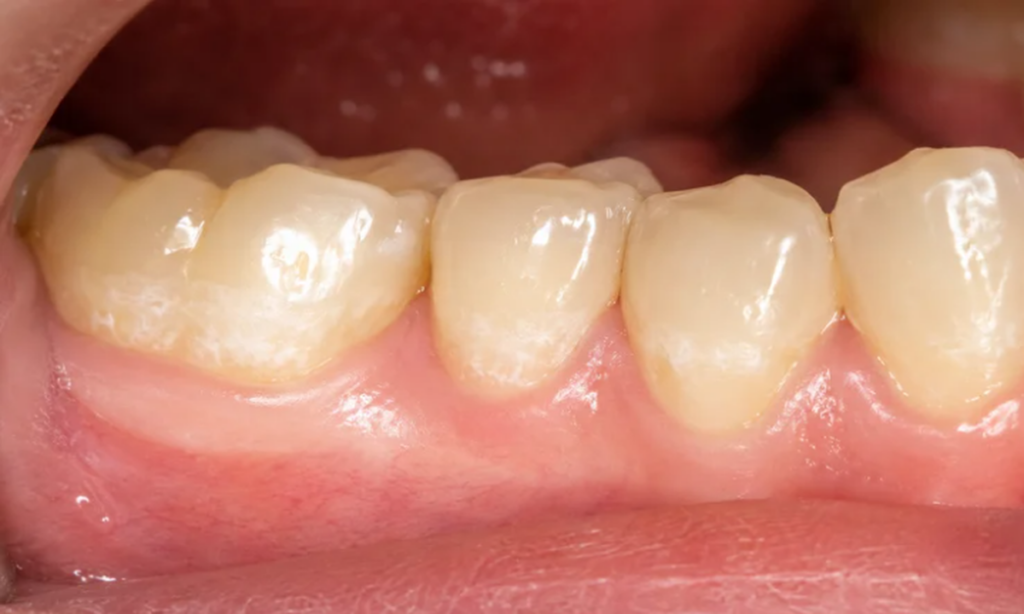
This is the true starting stage of tooth decay. Acid produced by plaque bacteria strips minerals from the enamel surface, leaving it weaker than before. You may notice small white or chalky spots, particularly near the gumline or between teeth, but there is no cavity yet and usually no pain or sensitivity at all.
This stage is fully reversible. Fluoride toothpaste, improved brushing technique, cutting back on sugary snacks, and increasing saliva flow through drinking water can restore mineral balance before any permanent damage sets in. Many patients walk around with early demineralisation for months without realising it, since it produces no symptoms and is often only picked up during a routine visit to a dentist in Vasanth Nagar, Bangalore.
Stage 2: Enamel Decay
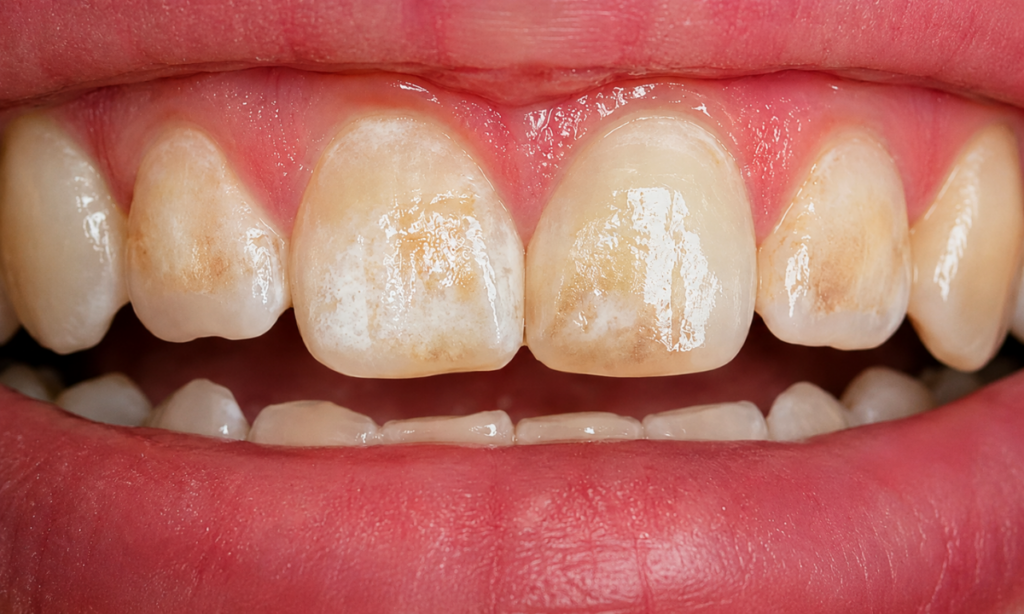
Left unchecked, demineralisation progresses to structural breakdown of the enamel itself. White spots can darken to a brownish shade, and the surface may start to feel rough or slightly pitted under your tongue or fingernail. There’s still no cavity into the deeper tooth structure at this point, but this is the last stage where a simple cleaning and remineralising treatment can fully resolve the issue without any drilling.
Once the enamel surface actually breaks and a hole begins to form, the decay has moved past this reversible window, which is why catching Stage 2 quickly matters almost as much as catching Stage 1.
Stage 3: Dentin Decay
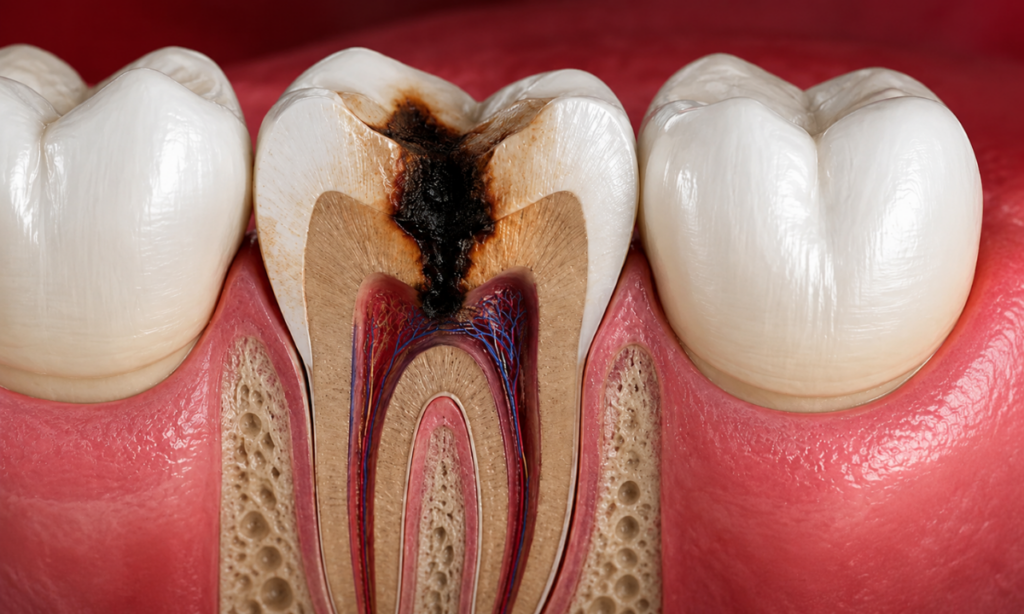
Once decay breaks through the enamel, it reaches the dentin, the softer, more porous layer underneath. Dentin decays considerably faster than enamel because it contains microscopic tubules that lead directly toward the tooth’s nerve, a structure the American Dental Association notes is why untreated cavities tend to progress more quickly once past the enamel layer. This is typically when patients first feel sensitivity to hot, cold, or sweet foods and drinks.
A visible cavity usually forms at this stage, and a filling is generally required to remove the decayed material and seal the tooth. Left untreated, decay in the dentin can spread surprisingly quickly compared to the slower enamel stages, sometimes progressing to the pulp within a matter of months. If you’re weighing up options once a cavity has formed, it helps to understand the filling for cavities process and what it typically costs.
Stage 4: Pulp Involvement
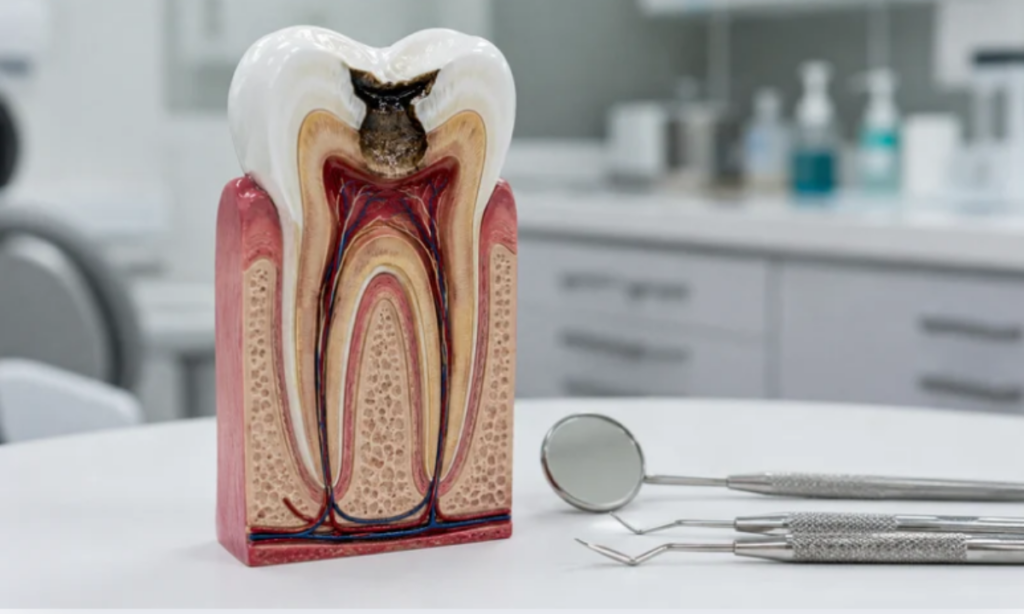
Decay reaching the pulp, the innermost layer containing nerves and blood vessels, causes noticeable pain, swelling, or lingering sensitivity that doesn’t go away when the trigger is removed. Some patients describe a dull, persistent ache, while others experience sharp pain when biting down.
At this stage, root canal treatment is usually the only way to save the natural tooth. The infected or inflamed pulp tissue is removed, the canal is cleaned and sealed, and the tooth is typically capped with a crown afterwards for strength. Delaying treatment here significantly raises the risk of the infection spreading into the surrounding bone.
Stage 5: Abscess Formation
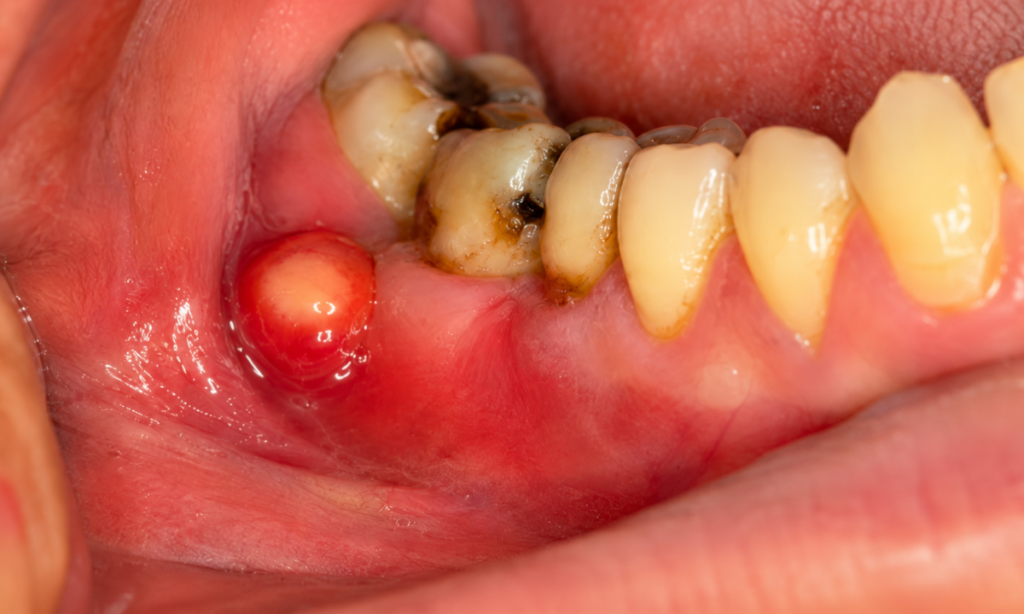
The final and most serious stage occurs when bacterial infection spreads beyond the tooth root, forming a pocket of pus known as an abscess. Symptoms include severe, throbbing pain, facial or gum swelling, fever, tender lymph nodes, and sometimes a foul taste from draining pus.
This is a dental emergency requiring immediate treatment to prevent the infection reaching the jaw bone or, in rare but serious cases, spreading into the bloodstream. Treatment usually involves draining the abscess, a course of antibiotics, and either root canal treatment or extraction depending on how much the tooth structure can be saved.
Who Is Most at Risk of Faster Tooth Decay
Certain factors accelerate the journey through these stages:
- Frequent snacking or sipping sugary drinks throughout the day
- Dry mouth, whether from medication, breathing patterns, or medical conditions, which reduces saliva’s protective effect
- Poor access to fluoride, whether through toothpaste, water, or professional treatments
- Deep grooves or crowding that trap plaque in hard-to-clean areas
- Acid reflux or frequent vomiting, which exposes teeth to stomach acid
- Skipping regular dental check-ups, which means early stages go undetected
How to Stop Tooth Decay at the Starting Stage
- Brush twice daily with fluoride toothpaste, focusing on the gumline
- Floss daily to clear plaque from between teeth where a brush cannot reach
- Limit frequent sugary or acidic snacking, especially between meals
- Use fluoride mouth rinses if recommended by your dentist
- Drink plenty of water to support natural saliva flow
- Visit a dentist for a check-up every six months
According to Dr. Chinmaya Bhandary (MDS Prosthodontics), Clinical Director at Beyond Dental Clinic, “most patients we see with early demineralisation have no idea anything is wrong. It’s only picked up during a routine examination, which is exactly why six-monthly check-ups matter so much. The earlier we catch it, the less invasive the treatment needs to be.”
Diet and Tooth Decay
What you eat matters just as much as how you brush. Tooth decay depends on two things: how much sugar reaches the bacteria in your mouth, and how long it lingers on your teeth before being cleared away. Sticky foods that cling to teeth, such as toffees and dried fruit, tend to cause more damage than foods quickly rinsed away by saliva. Frequent snacking throughout the day is often worse than eating the same sugar in one sitting, since each exposure triggers a fresh acid attack lasting up to thirty minutes.
Foods and drinks that increase decay risk:
- Sticky sweets, toffees, and dried fruit
- Fizzy drinks, sports drinks, and fruit juices
- Frequent snacking between meals
- Citrus fruits and vinegar-based foods sipped slowly
Foods and habits that help protect teeth:
- Cheese, milk, and yoghurt for remineralisation
- Crunchy vegetables like carrots and apples
- Sugar-free gum with xylitol after meals
- Plenty of fluoridated water throughout the day
Small changes to when and how often you eat sugar can matter more than cutting it out completely.
When to See a Dentist
Book an appointment as soon as you notice white spots, rough patches, or any sensitivity, rather than waiting for pain to appear. Pain typically signals Stage 3 or later, by which point a filling alone may no longer be enough to resolve the issue. Reach out to our dental clinic in Vasanth Nagar, Bangalore for early-stage screening and same-visit fluoride treatments where appropriate.
Conclusion
Tooth decay doesn’t happen overnight, and recognising which stage you’re at makes all the difference to how simple, or how invasive, the treatment needs to be. Catching things at the starting stage means a straightforward fluoride treatment; waiting until Stage 4 or 5 means a root canal or worse. Regular check-ups remain the single best way to catch demineralisation before it becomes a cavity, since the earliest stages rarely show any symptoms at all.
If you’ve noticed white spots, sensitivity, or any discomfort, don’t wait for the pain to get worse. Book a consultation with Beyond Dental in Vasanth Nagar, Bangalore, and let Dr. Chinmaya Bhandary and the team catch it early.
Frequently Asked Questions
What is the starting stage of tooth decay called?
The starting stage is called demineralisation, where acid weakens the enamel and creates white or chalky spots before any cavity forms.
Can tooth decay be reversed?
Yes, but only at Stage 1, and to some extent Stage 2. Once a cavity forms in the dentin, the damage is permanent and requires a filling or further treatment.
How long does it take tooth decay to progress through all stages?
This varies widely between patients, from months to years, depending on oral hygiene, diet, and saliva composition. Regular dental visits catch progression early regardless of speed.
Does tooth decay always cause pain?
No. Stages 1 and 2 are typically painless, which is why regular check-ups matter more than waiting for symptoms to appear.
Is tooth decay contagious?
The bacteria responsible for tooth decay can be transferred through saliva, such as sharing utensils or cups, which is why family members often show similar decay patterns.
Can children get tooth decay in baby teeth?
Yes, and untreated decay in baby teeth can affect the development and alignment of permanent teeth underneath, so early treatment matters just as much in children.