
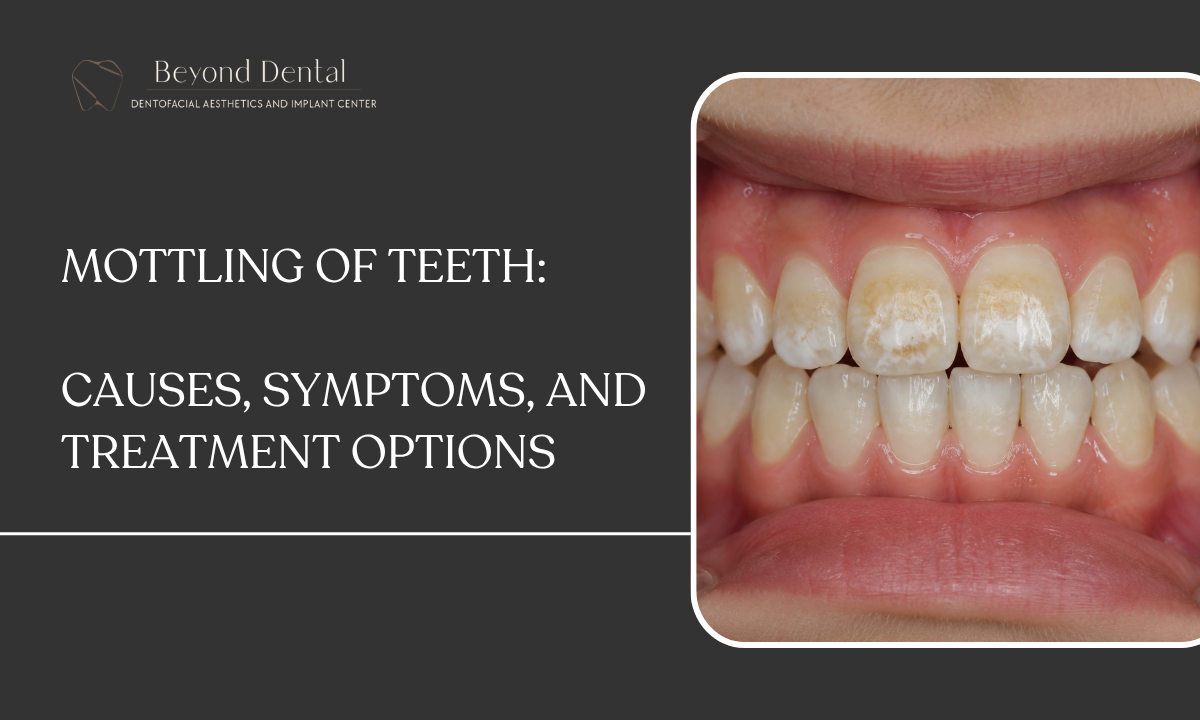
If you have noticed white, brown, or yellow patches unevenly spread across your teeth, you may be dealing with mottling of teeth. This is a common dental concern where the enamel develops discoloured patches instead of a smooth, uniform colour. Mottling of the teeth is mostly a cosmetic issue, but understanding the causes and treatment options can help you decide the right path forward.
At Beyond Dental, we regularly see patients concerned about mottled or discoloured teeth, and in this guide, we explain everything you need to know, from why it happens to how it can be treated.
What Is Mottling of Teeth?
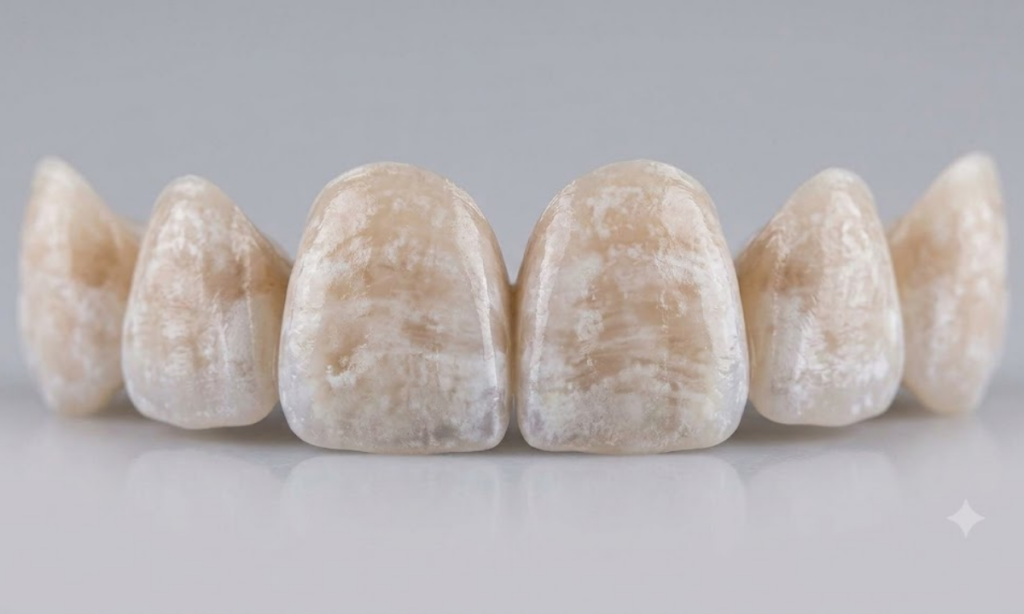
Mottling of teeth refers to the appearance of irregular white, brown, or yellowish-brown spots and streaks on the enamel surface. Unlike a single stain that develops from food or drink, mottling on teeth is a structural change in the enamel itself. It often develops during the years when teeth are forming beneath the gums, which means the pattern is usually visible as soon as the tooth erupts.
The severity can range from barely noticeable faint white flecks to more pronounced brown mottling of teeth that affects a person’s confidence when smiling. Mottling most commonly affects the front teeth, as these are the most visible when speaking or smiling, but it can occur on any tooth.
What Causes Mottling of Teeth?
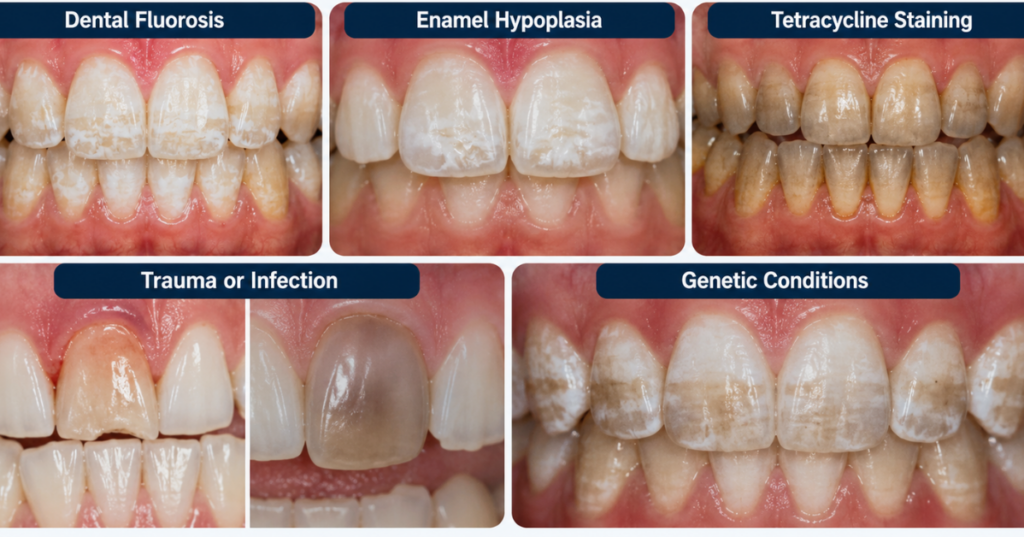
There are several reasons why teeth may develop this uneven, patchy appearance.
Dental Fluorosis
The most common cause of mottled teeth is dental fluorosis, which happens when the enamel is exposed to excessive fluoride during its formation. This can occur due to fluoridated water, fluoride toothpaste being swallowed rather than spat out, or fluoride supplements taken in high doses. In mild cases, the result is enamel that appears chalky white; in more advanced cases, it develops into brown mottling of teeth that can look pitted or stained. According to the NIDCR, fluorosis mainly affects children up to about eight years old, since this is when most permanent teeth are still developing under the gums.
Enamel Hypoplasia
This is a condition where the enamel does not form properly due to nutritional deficiencies, illness, or genetic factors during tooth development. It can leave teeth with thin, weak patches that appear discoloured or rough, contributing to mottling of the teeth even without fluoride exposure.
Tetracycline Staining
Certain antibiotics, particularly tetracycline, can cause intrinsic staining if taken during the period of tooth formation. This typically results in grey or brown banding across the teeth rather than the more speckled look of fluorosis.
Trauma or Infection
An injury to a developing tooth, or an infection in a baby tooth that affects the permanent tooth forming beneath it, can also cause localised discolouration and mottling on teeth.
Genetic Conditions
Rare genetic conditions affecting enamel formation, such as amelogenesis imperfecta, can also result in mottled or discoloured teeth, though this is far less common than fluorosis..
Can Mottling of Teeth Be Prevented?
While existing mottling generally requires treatment to correct, being mindful of fluoride exposure, such as using an appropriate amount of fluoride toothpaste and avoiding excessive fluoride supplements, can help reduce the risk of new mottling of teeth developing in children whose teeth are still forming. Maintaining good oral hygiene and having regular dental check-ups also helps catch enamel issues early, before they progress further.
A few simple habits can go a long way, especially for parents of young children whose permanent teeth are still developing:
- Use the right amount of toothpaste – a pea-sized amount for children aged 3 to 6, and a rice-grain-sized smear for children under 3, to limit how much fluoride they may accidentally swallow.
- Supervise brushing in young children – encourage them to spit out toothpaste rather than swallow it, since children under 6 often swallow much of what’s on the brush.
- Avoid unnecessary fluoride supplements – only give fluoride drops or tablets if specifically recommended by a paediatrician or dentist based on your child’s fluoride exposure from water and diet.
- Check your drinking water source – if your water supply already has higher natural fluoride levels, additional fluoride toothpaste or supplements may not be needed.
- Keep up with regular dental visits – routine check-ups help catch early signs of fluorosis or enamel issues while treatment options are still simple and conservative.
Being proactive about these habits during the early years of tooth development, roughly up to age 8, is the most effective way to reduce the chances of mottling appearing on permanent teeth.
Symptoms of Mottled Teeth
Mottling of teeth is primarily a visual concern, but there are several signs to look out for that can help you identify it and understand its severity:
- Irregular white spots or streaks on the enamel – these are often the earliest and mildest sign, particularly with fluorosis, and may only be noticeable in certain lighting.
- Brown or yellowish-brown patches, especially in more advanced cases of brown mottling of teeth, where the discolouration becomes darker and more defined over time.
- Rough or pitted enamel texture in severe fluorosis, where the enamel surface itself is affected, not just its colour.
- Uneven colour distribution across the same tooth or between different teeth, so some teeth may appear more affected than others depending on when they were forming.
- Lines or streaks running horizontally across the tooth surface, which is a common pattern seen in fluorosis-related mottling.
- A chalky or opaque appearance, particularly in milder cases, before the enamel darkens into brown staining.
- Mild sensitivity in some cases, if the enamel is thinner than normal, though this is far less common than the visual changes.
- Symptoms present from the time the tooth erupts, since mottling develops during tooth formation rather than appearing gradually like typical surface staining.
Most cases of mottling do not cause pain or sensitivity, as the underlying tooth structure is usually still intact and functions normally for biting and chewing. The concern is largely cosmetic, affecting how the teeth look rather than how they function. That said, in more severe cases where the enamel is pitted or weakened, teeth can become more prone to wear or minor chipping over time, which is why a dental evaluation is worthwhile even when there is no pain involved.
Diagnosing Mottling of Teeth
A dentist can usually diagnose mottling of the teeth through a simple visual examination, distinguishing it from other causes of tooth discolouration such as surface staining from tea, coffee, or tobacco. Your dentist will look at the pattern, distribution, and colour of the patches to determine the underlying cause, whether that is fluorosis, hypoplasia, tetracycline staining, or something else. This distinction matters because it affects which treatment will give the best results.
The diagnostic process typically includes a few key steps:
- Visual examination under good lighting – the dentist checks the location, shape, and colour of the spots or streaks, since different causes tend to produce different patterns.
- Reviewing dental and medical history – questions about childhood fluoride exposure, use of certain antibiotics during early years, or any illness or trauma during tooth development can help pinpoint the cause.
- Checking symmetry across teeth – fluorosis often affects multiple teeth in a fairly symmetrical pattern, while trauma-related mottling is usually limited to a single tooth or a small group.
- Assessing enamel texture – the dentist may gently examine the surface to check whether it is smooth, rough, or pitted, which helps indicate severity.
- Ruling out early tooth decay – since decay can sometimes present with discoloured patches too, the dentist confirms that the enamel structure is intact and that the changes are related to mottling rather than cavities.
- X-rays, if needed – in some cases, especially where trauma or infection is suspected as the cause, dental X-rays may be taken to check the health of the tooth beneath the surface.
Dental professionals typically use a standard visual index to grade the severity of fluorosis, ranging from very mild, barely visible white flecks to severe cases with brown staining and enamel pitting. This grading helps guide which treatment approach, from conservative options like microabrasion to more involved solutions like veneers, would be most appropriate for your specific case.
Treatment Options for Mottling of Teeth
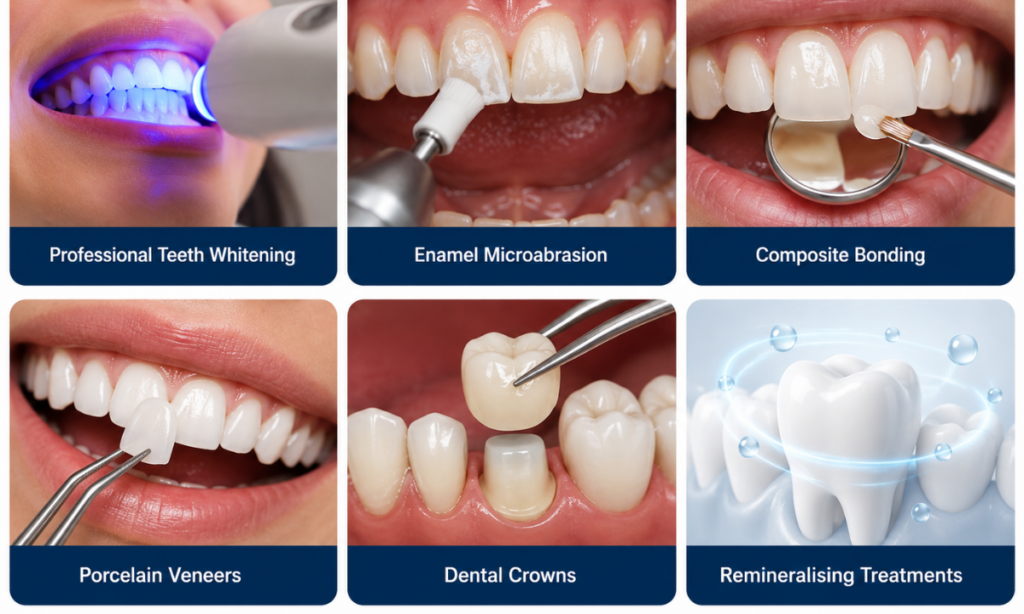
The right treatment depends on how severe the mottling is and what is causing it. Here are the main options available.
| Treatment | Best For | Procedure Time | Longevity | Invasiveness |
|---|---|---|---|---|
| Professional Teeth Whitening | Mild yellow/brown discolouration | 1 visit | 6 months to 2 years | Non-invasive |
| Enamel Microabrasion | Mild to moderate white/brown spots | 1 visit | Long-lasting (permanent removal of stained layer) | Minimally invasive |
| Composite Bonding | Moderate mottling, budget-friendly fix | 1–2 visits | 5–7 years (may need touch-ups) | Minimally invasive |
| Porcelain Veneers | Severe or widespread mottling, cosmetic priority | 2–3 visits | 10–15 years | Moderately invasive (slight enamel reduction) |
| Dental Crowns | Mottling with structural enamel damage | 2–3 visits | 10–15+ years | Invasive (full tooth coverage) |
| Remineralising Treatments | Supportive/preventive, not standalone fix | Ongoing | Ongoing maintenance | Non-invasive |
Mottled Teeth Whitening
For milder cases, professional teeth whitening can help even out the overall colour of the teeth. Mottled teeth whitening works better on yellow and brown discolouration than on white fluorosis spots, and in some cases, the white spots can become more noticeable once the surrounding enamel is lightened. This is why home whitening kits are not recommended for mottling, and a dentist should assess whether whitening is suitable before starting treatment.
Enamel Microabrasion
Microabrasion is a conservative, minimally invasive technique in which a mildly abrasive compound is used to gently polish away the outermost, stained layer of enamel. This is often effective for mild to moderate mottling, particularly fluorosis-related white and brown spots, and can be done in a single visit with immediate results.
Composite Bonding
For more noticeable mottling, composite bonding involves applying a tooth-coloured resin over the affected areas to mask discolouration and restore a smooth, even appearance. It is a cost-effective and minimally invasive option, though the resin may need touch-ups over time as it can pick up stains.
Porcelain Veneers
When mottling is more severe or covers a larger area, porcelain veneers offer a longer-lasting cosmetic solution. These thin shells are custom-made to fit over the front surface of the teeth, providing a natural, stain-resistant finish. Veneers involve a small amount of enamel reduction and are a good option for those looking for a permanent cosmetic improvement.
Dental Crowns
In cases where mottling is accompanied by structural enamel damage or weakened teeth, your dentist may recommend a crown. Many patients searching for dental crowns in Bangalore are looking for exactly this kind of solution, where the tooth needs more than a cosmetic fix. Crowns fully cover the tooth, restoring both its appearance and function, and are typically used when the damage goes beyond a purely cosmetic concern.
Remineralising Treatments
Fluoride varnishes and remineralising pastes containing casein phosphopeptide (CPP-ACP) can help strengthen enamel over time. These are generally used as a supportive measure alongside cosmetic treatment rather than a standalone fix for existing mottling. The American Dental Association notes that remineralising agents work best when combined with good daily oral hygiene rather than as a stand-alone cosmetic fix.
Which Treatment Is Right for You?
Choosing the right treatment depends on several factors: how severe the mottling on teeth is, whether it is purely cosmetic or involves weakened enamel, your budget, and how long-lasting you want the results to be. Mild cases often respond well to microabrasion or mottled teeth whitening, while more pronounced brown mottling of teeth usually calls for bonding, veneers, or crowns for a longer-term solution.
A couple of things worth keeping in mind: if only one or two teeth are affected, a targeted fix like bonding or a single veneer is often enough, while widespread mottling may need a combination approach for a consistent result. Similarly, whitening and bonding are quicker and more affordable but may need touch-ups over time, whereas veneers and crowns cost more upfront but last significantly longer.
At Beyond Dental, our team evaluates each case individually to recommend the most suitable treatment, whether that is a conservative approach like microabrasion or a more comprehensive cosmetic solution. If you are looking for a trusted dental clinic in Vasanth Nagar, Bangalore for cosmetic concerns like mottled or discoloured teeth, our clinic offers a full range of assessment and treatment options tailored to your needs.
What to Expect During Treatment
Most treatments for mottling of the teeth begin with a consultation, where the dentist examines the pattern and severity of discolouration and discusses your goals, whether that’s a subtle improvement or a complete cosmetic transformation. For conservative options like microabrasion or bonding, results are often visible the same day. Veneers and crowns involve a bit more planning, including impressions or digital scans, temporary restorations while the permanent ones are made, and a fitting appointment. Your dentist will also walk you through aftercare, such as avoiding staining foods and drinks for the first 24 to 48 hours after bonding or whitening.
A quick overview of what this looks like at each stage:
- Consultation pattern and severity assessment, discussion of your goals
- Conservative treatments (microabrasion, bonding) results visible the same day
- Veneers and crowns impressions or digital scans, temporary restoration, followed by a fitting appointment
- Mild sensitivity may last a day or two, usually settles on its own
- Aftercare avoid staining foods and drinks (tea, coffee, red wine) for 24–48 hours after bonding or whitening
Overall, most patients are able to return to their regular routine within a day or two, with results that continue to look natural as the treated areas settle in.
Final Thoughts
Mottling of teeth, while mostly a cosmetic concern, can affect confidence in your smile. The good news is that with the range of treatments available today, from micro abrasion and mottled teeth whitening to veneers and crowns, there is a suitable solution for nearly every case. If you are searching for an experienced dentist in Vasanth Nagar, Bangalore to assess your teeth and recommend the best course of action, our team at Beyond Dental is here to help you achieve a smile you feel confident about.
Frequently Asked Questions
What is mottling of teeth?
Mottling of teeth is an irregular, patchy discolouration of the enamel, appearing as white, brown, or yellowish-brown spots and streaks. It is most commonly caused by dental fluorosis, though enamel hypoplasia, tetracycline staining, and developmental trauma can also cause it.
Is mottling of teeth the same as tooth decay?
No. Mottling is a discolouration or textural change in the enamel, often caused by fluorosis or developmental issues, whereas tooth decay involves the breakdown of tooth structure due to bacterial activity. They can look similar in early stages, so a dental assessment is the best way to tell them apart.
Can mottled teeth be whitened at home?
Over-the-counter whitening kits are generally not recommended for mottled teeth whitening, as they can unevenly lighten the enamel and make white spots more prominent. Professional evaluation is a safer route to achieve a natural, even result.
How long does treatment for mottling on teeth take?
This depends on the treatment chosen. Microabrasion can often be completed in a single visit, composite bonding usually takes one to two visits, and veneers or crowns may take a few visits to design and fit.
Does mottling of the teeth affect oral health?
In most cases, mottling is a cosmetic issue rather than a health concern, and the tooth remains structurally sound. However, in more severe fluorosis or hypoplasia cases, the enamel can be weaker and more prone to wear, which is why a dental evaluation is recommended.