
If your dentist has mentioned an inlay or an onlay, you may be left feeling slightly puzzled about what it actually means. It is not a simple filling, and it is not quite one of the dental crowns you may already have heard of either. Instead, it sits somewhere in between the two, and that in-between position is exactly what makes these restorations so useful. They allow a dentist to repair a tooth that is too damaged for a basic filling, yet still healthy enough to avoid the more involved step of a full crown.
For many patients, this is the first time they have come across the terms at all, so a little confusion is completely understandable. The good news is that the idea behind them is straightforward once it is explained clearly. This guide covers inlays and onlays for teeth in plain, practical terms. We look at what they are, how they differ from fillings and crowns, when you genuinely need one, what the procedure feels like from start to finish, and how to care for them properly afterwards. By the end, you should have enough understanding to feel confident about whatever your dentist recommends, and to ask the right questions if anything is still unclear.
What Are Inlays and Onlays?
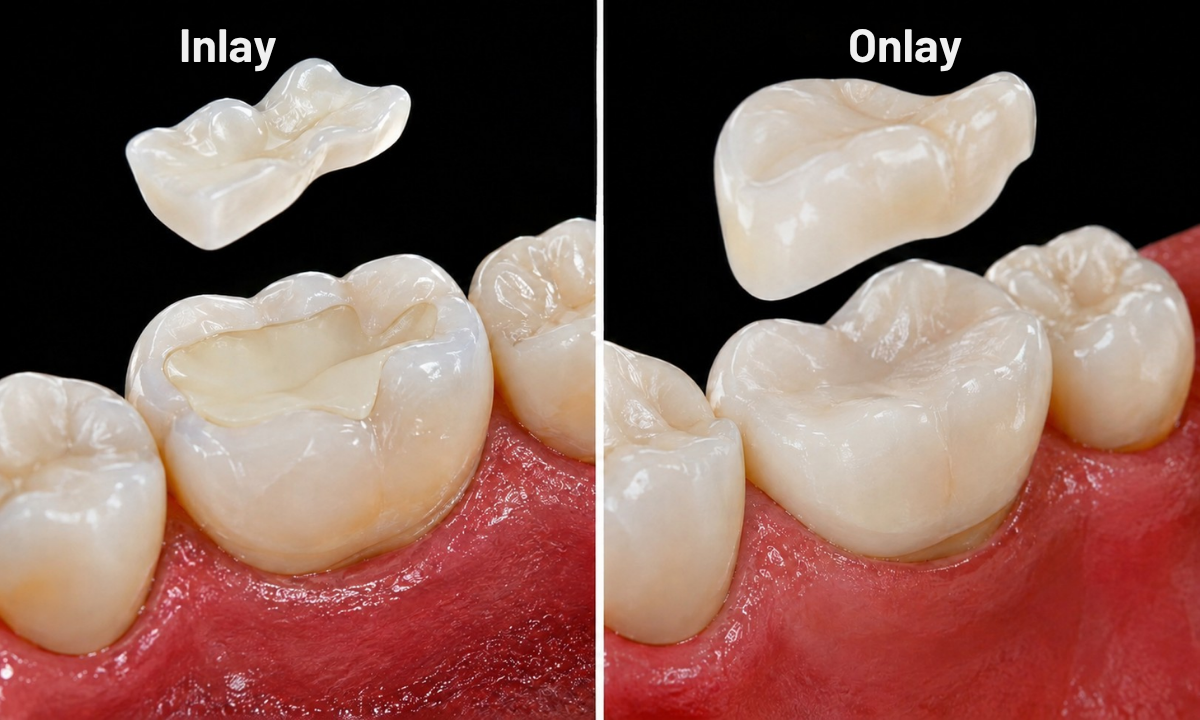
Inlays and onlays are custom-made restorations used to repair a tooth that has moderate decay or damage. Instead of being shaped directly inside your mouth like a standard filling, they are made to fit your tooth precisely and then bonded into place. Because they are made outside the mouth and fitted afterwards, dentists refer to them as indirect restorations.
The difference between an inlay and an onlay is simply how much of the tooth they cover.
- An inlay fits inside the tooth, within the raised points known as cusps. It is used when the damage is contained in the central chewing surface and does not spread to the outer edges.
- An onlay covers more ground. It restores the centre of the tooth and extends over one or more of the cusps. It is used when the damage reaches the outer points, but a full crown would be more than the tooth actually needs.
Both are made from strong, durable materials such as porcelain, ceramic, composite resin, or, in some cases gold. Tooth-coloured porcelain and ceramic are by far the most popular choices today, because they blend in so naturally that the repair is almost impossible to spot once fitted.
Inlays and Onlays in Dentistry: Why They Matter
The real value of inlays and onlays in dentistry comes down to a single principle: keeping as much of your natural tooth as possible.
Every time a tooth is treated, the goal is to remove the damage while protecting what remains healthy. The more of your own tooth that stays intact, the stronger and more resilient it tends to be over the years. This is where inlays and onlays come into their own.
Consider the alternatives. A very large filling can leave a tooth weakened because it takes up space without adding much structural strength, and over time, that tooth becomes more prone to cracking. A crown, at the other end of the scale, requires the dentist to file down a significant amount of healthy tooth so the cap can fit over it. Inlays and onlays offer a middle path. They repair and reinforce the tooth without going to either extreme.
This is why they have become a cornerstone of what dentists call conservative dentistry, the modern philosophy of preserving natural teeth wherever it is sensible to do so rather than reaching for the most invasive fix.
Inlay/Onlay Restoration: What the Procedure Involves
An inlay/onlay restoration is usually completed across two appointments, though many clinics now offer same-day treatment using digital scanning and in-house milling.
The process generally runs like this:
- First visit. The dentist numbs the area, removes the decayed or damaged part of the tooth, and cleans it thoroughly. A digital scan or physical impression of the prepared tooth is then taken. This is sent to a dental laboratory or processed on-site, where your custom inlay or onlay is made to match the exact shape of your tooth. A temporary restoration may be placed to protect the tooth in the meantime.
- Second visit. Once your inlay or onlay is ready, the temporary is removed, and the new restoration is checked carefully for fit and bite. When it sits perfectly, it is bonded firmly into place with dental adhesive and polished so it feels smooth and completely natural.
The entire procedure is carried out under local anaesthetic, so you should not feel any pain during treatment. Most patients say the experience is very similar to having a filling, just with an extra step in between while the restoration is made. If you have any concerns about comfort beforehand, an experienced dentist in Vasanth Nagar, Bangalore, will talk you through each stage so you know exactly what to expect.
Inlays, Onlays, and Crowns: How They Compare
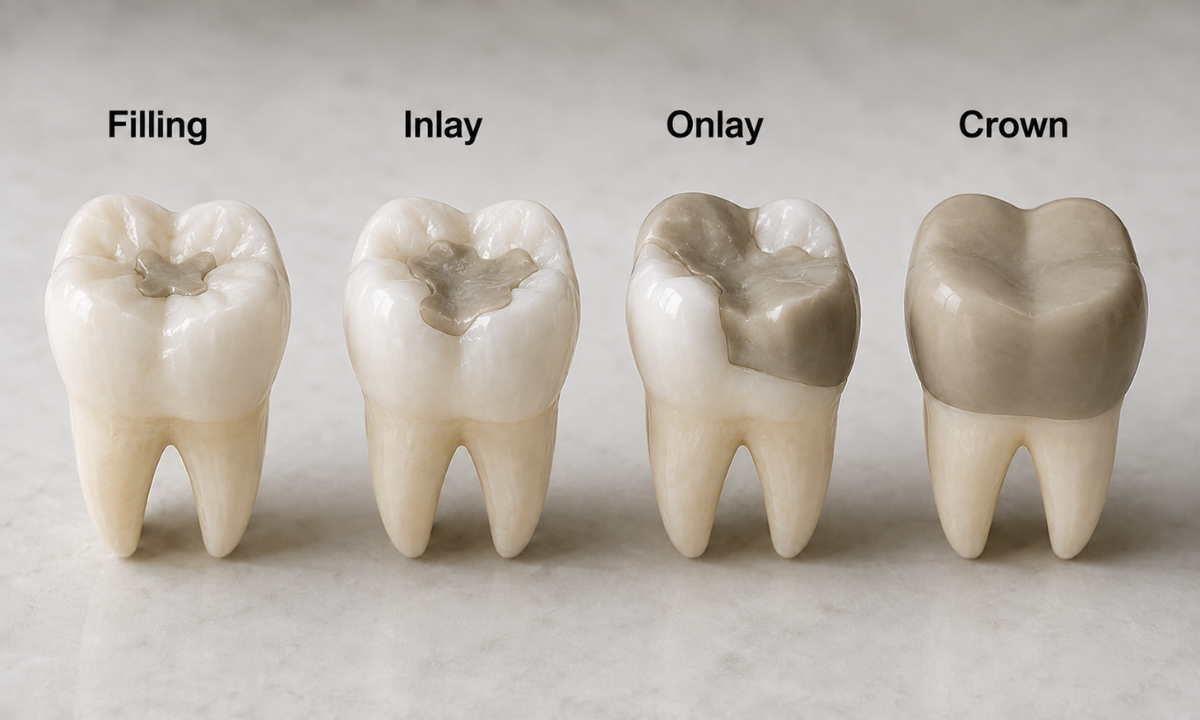
One of the most common questions patients ask is how these treatments differ from one another. When people search for inlays, onlays crowns, they are usually trying to work out which option preserves the most of their natural tooth and which one their situation actually calls for.
The simplest way to picture it is a sliding scale. As the damage to a tooth increases, so does the amount of coverage needed to repair it. The table below sets it out clearly.
| Treatment | Best for | Tooth coverage | Natural tooth preserved |
|---|---|---|---|
| Filling | Small cavities | Fills a small area | Most, but can weaken the tooth if large |
| Inlay | Moderate damage in the centre | Sits within the cusps | High |
| Onlay | Larger damage reaching the cusps | Covers the centre and one or more cusps | High, more than a crown |
| Crown | Heavily damaged or cracked teeth | Caps the entire tooth | Least, the tooth is filed down |
A good dentist will always recommend the most conservative option that will properly do the job. This is exactly why an onlay is so often chosen instead of a crown when the tooth can still be saved. It protects the tooth as a crown would, but keeps far more of your natural structure intact.
When Do You Need an Inlay or Onlay?
Your dentist may suggest an inlay or onlay in several common situations:
- A cavity is too large for a filling, but the tooth is not damaged enough to justify a crown
- An old or failing filling needs to be replaced with something stronger and longer-lasting
- A tooth has a crack or fracture that has not yet reached the root
- A back tooth that takes heavy chewing pressure needs a durable, natural-looking repair
In our experience at Beyond Dental Clinic, the patients who benefit most from onlays are often those who walk in expecting a crown, usually because a large old filling has finally started to fail. Once the tooth is properly assessed, there is frequently enough healthy structure left to save it with an onlay instead.
Dr Chinmaya Bhandary notes that this is one of the more satisfying conversations to have with a patient, because they arrive braced for the most invasive option and leave keeping far more of their natural tooth than they expected. The key is catching the problem before a crack spreads towards the root, which is one more reason not to put off a check-up when a filling starts to feel loose or sensitive.
Because they are custom-made and bonded securely, inlays and onlays tend to outlast large fillings by a wide margin, often lasting well over a decade with good care. They also resist staining and hold their shape under the daily pressure of chewing.
The Benefits at a Glance
Here is why patients and dentists so often favour these restorations:
- They preserve your natural tooth, which keeps it stronger and healthier for longer
- They are hard-wearing, standing up well to years of daily chewing
- They look natural, as porcelain and ceramic are matched to your own tooth colour
- They resist staining and hold their appearance over time
- They protect against further damage by reinforcing a weakened tooth and reducing the risk of future cracks
Looking After Your Inlays and Onlays
One of the reassuring things about these restorations is that they need no special maintenance. You simply care for them the way you care for the rest of your teeth:
- Brush twice a day and floss daily to keep the edges clean
- Keep up with your regular dental check-ups so any issues are caught early
- Avoid chewing hard items such as ice, and do not use your teeth to open packaging
- If you grind your teeth at night, ask your dentist about a nightguard, which protects both your natural teeth and your restorations
With sensible care, a well-fitted inlay or onlay can serve you reliably for many years. For general guidance on keeping teeth and restorations healthy, the Oral Health Foundation offers clear and reliable advice.
A Trusted Approach in Vasanth Nagar
Precision matters a great deal with these restorations, from the first assessment right through to the fit of the final piece. A restoration that fits even slightly poorly can trap food or affect your bite, so it is worth seeing a dentist who takes the time to get every detail right.
At Beyond Dental Clinic, a well-regarded dental clinic in Vasanth Nagar, Bangalore, restorative treatments are carried out with careful attention to detail. Under the guidance of Clinical Director Dr Chinmaya Bhandary, the team assesses each tooth thoroughly and recommends only the most conservative option that will protect it well, whether that turns out to be a filling, an inlay, an onlay, or a crown.
As an experienced dentist in Vasanth Nagar, Bangalore, the focus stays firmly on preserving your natural teeth and explaining each step clearly, so you always understand what is being recommended and why.
Frequently Asked Questions
How long do inlays and onlays last?
With good oral hygiene and regular check-ups, they commonly last ten years or more, and often considerably longer. Their lifespan depends largely on the material used and how well you care for them.
Are inlays and onlays better than fillings?
For moderate damage, generally yes. They are stronger, last longer, and preserve more of the tooth than a large filling would. For very small cavities, however, a simple filling is still the more sensible choice.
Does the procedure hurt?
No. It is carried out under local anaesthetic, so you should not feel pain during treatment. Some mild sensitivity afterwards is normal and usually settles within a few days.
Can an inlay or onlay come loose or fall out?
It is uncommon, but possible, usually if the bond weakens over many years or the tooth beneath develops new decay. If a restoration ever feels loose, see your dentist promptly so it can be checked and re-bonded before any further damage occurs.
Is an onlay always better than a crown?
Not always. An onlay is preferable when there is enough healthy tooth left to support it, as it preserves more of your natural structure. If a tooth is very heavily damaged or cracked, a crown may be the safer long-term option. A thorough assessment is the only way to know which is right for your particular tooth.
Will people be able to tell I have one?
Very unlikely. Porcelain and ceramic inlays and onlays are matched to your natural tooth shade, which makes them extremely difficult to notice, even up close.
For further reading on restorative treatments, the American Dental Association offers trusted, patient-friendly oral health information.